









导语:First Impressions of Longhui .If judged by global standards of national happiness indices, Longhui would undoubtedly score full marks.-----By Mr. Wu Peiqing
From November 1st to 3rd, 2024, at the invitation of the Shaoyang Municipal People's Government, our magazine team—comprising three members—and two representatives from Hunan Radio traveled to Longhui County in Shaoyang City to conduct research on international cultural and tourism development. On the evening of our first day, we paid a visit to Mr Yuan Shuxiong, Longhui County’s renowned composer. As is widely known, during the pandemic in 2023, Yuan composed the powerful and uplifting song “Good Morning, Longhui.” The track unexpectedly went viral nationwide after being used online as the background music celebrating Lionel Messi—the football star—during the Qatar World Cup. In 2024, “Good Morning, Longhui” was performed on China Central Television’s Spring Festival Gala, catapulting Longhui—a small county with a population of over one million—into a trending topic with tens of billions of online mentions. It truly became a case where a single song revitalized an entire city. At the time, Mr Diego Ramiro Guelar, Argentina’s Ambassador to China, made a special trip to Longhui to meet Yuan Shuxiong and even sang “Good Morning, Longhui” together with him.
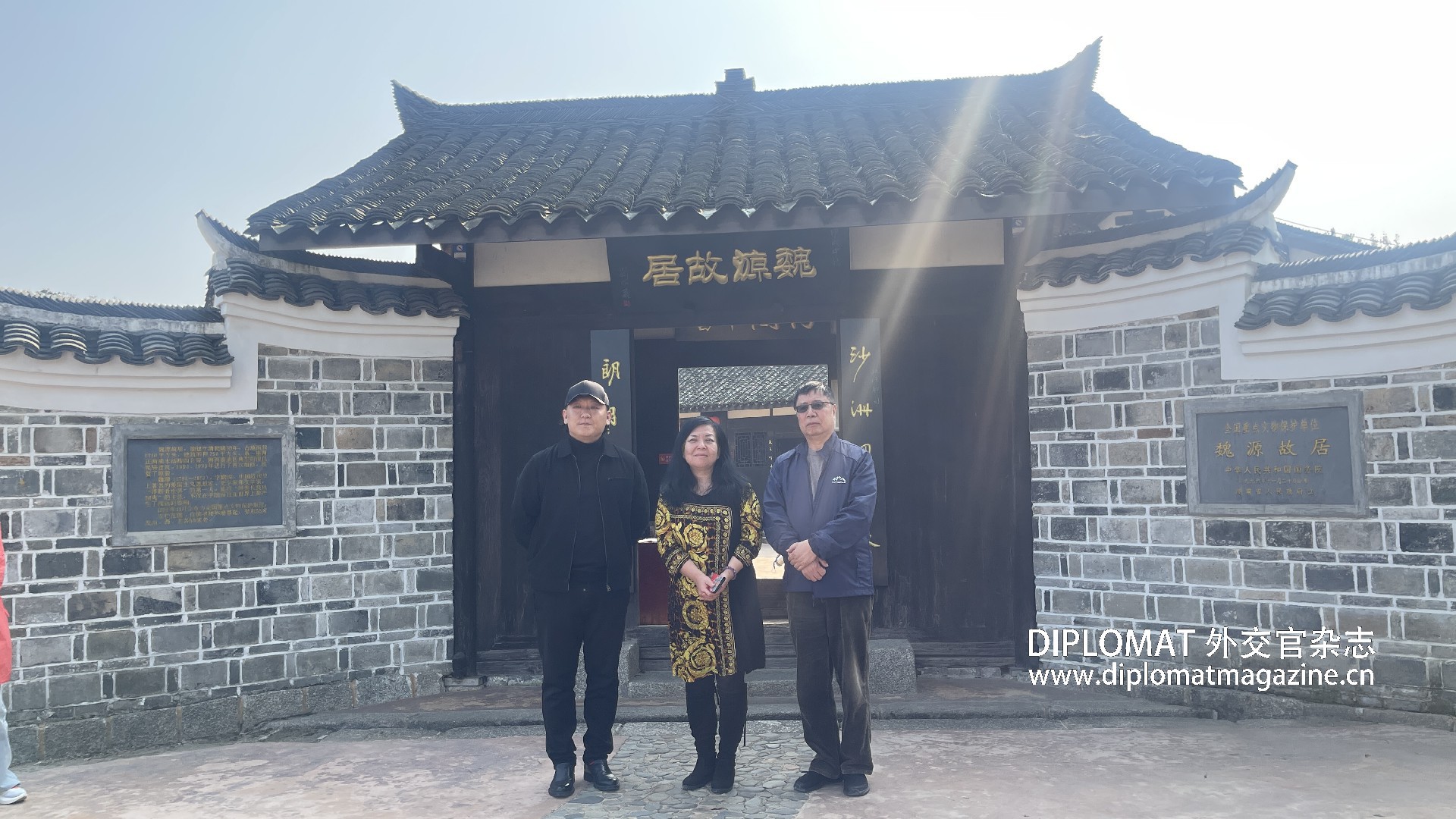
During a three-day visit accompanied by the Longhui County Government, we followed the footsteps of Mr Diego Ramiro Guelar to explore the Longhui Wei Yuan Memorial Hall (a cultural landmark symbolizing 'opening eyes to the world'), the Longhui Tantou Woodblock New Year Painting Museum, the Fumeixiang Tantou New Year Painting Workshop, the Longhui Rural Revitalization Agricultural Products Exhibition Hall, and the renowned Longhui Huayao Village.
Nestled among the steep mountains of Huxing Ridge on the eastern foothills of the Xuefeng Mountains—at an elevation of 1,300 meters—lives the Huayao ethnic minority with around 20,000 people. They are named “Huayao” (literally “Flower Yao”) due to their distinctive, vibrantly colored traditional attire, especially the women’s exquisite “tiaohua” embroidery skills.
Among the most memorable experiences of our journey were the Grassland School in Huayao Township, the Qijiang Tanhua Dance bonfire evening event, the Ancient Tree Park and heritage homestays in Chongmudang Village, and the immersive performance “Huayao Wedding Banquet”—all of which left an indelible impression on us.
Here, we briefly revisit a few highlights from our trip.
Huayao Township Grassland School
At four o’clock on the afternoon of November 2nd, we arrived at the Grassland School. It was a day off, but upon hearing that guests from Beijing were coming to visit their school, the children gave up their rest and came to the school early from their homes, waiting eagerly in the school playground. The school is small, with just a two-story building and a playground covering a few hundred square meters. However, the genuine warmth and enthusiasm of the children deeply moved me. As soon as we reached the school playground, the children lined up neatly and, under the guidance of their teachers, welcomed us with applause. They then performed traditional dances of their ethnic minority. Afterwards, they pulled editor-in-chief Ren and me into joining them, clapping our hands to the rhythm and dancing together with bamboo poles. Deputy County Magistrate Yang from Longhui also joined in the hand-in-hand circle spinning game. Playing with the children made me feel like I had instantly returned to my childhood, despite being seventy years old; it was truly delightful to retain my childlike innocence!
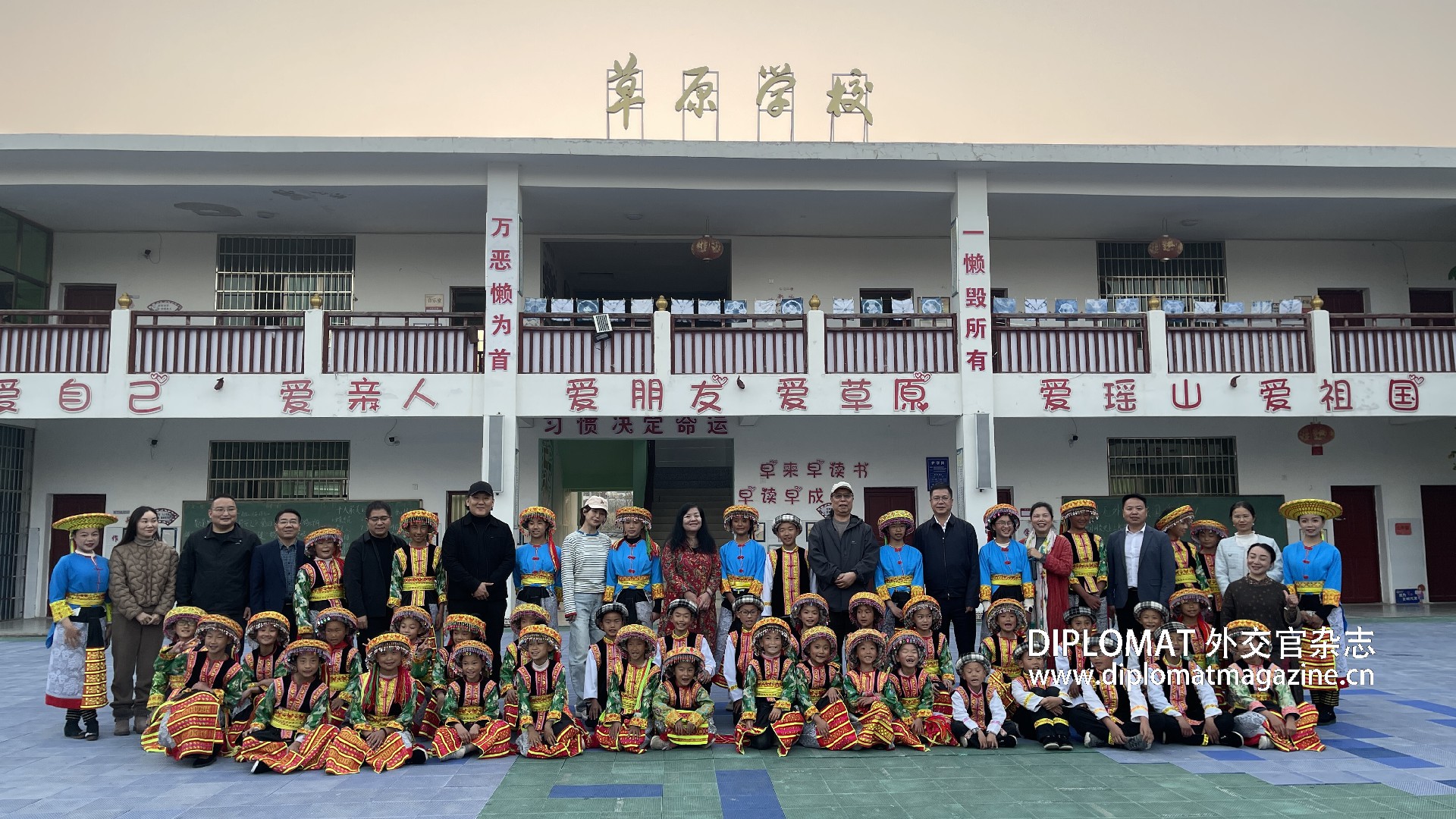
After the game ended, six or seven students wearing red scarves accompanied us hand in hand to tour their classrooms: we saw their desks and chairs; admired the drawings they had drawn in the classroom; viewed photos from each of their extracurricular activities displayed along the school corridors; and appreciated the tie-dyed handkerchiefs they had created under their teacher's guidance—each item a testament to the dedication, hard work, and academic achievements of both teachers and students.
Ms. Tan Meizhen, the principal of Caoyuan School, voluntarily left her teaching position in a school in Shaoyang City several years ago to become a teacher at this rural school in the mountainous grasslands. Under her leadership, the school has grown from just one teacher and seven students to now having eight teachers and over 200 students. The curriculum has expanded from only lower primary grades to encompass Grades 1 to Grade 7. The school’s remarkable development reflects the sweat and unwavering commitment of a teacher wholeheartedly devoted to education.
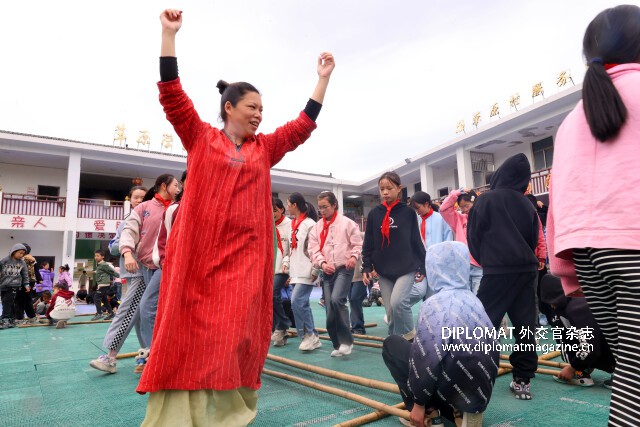
The Tang dynasty poet Li Shangyin once wrote, “The silkworm spins silk until it dies; the candle burns to ash before its tears dry.” Indeed, even in humble classrooms nestled in remote mountainous regions, with innocent children as their pupils, teachers who embody the selfless spirit of the spring silkworm and the burning candle—offering genuine love, warmth, and illumination—can still nurture students who excel in moral character, intellect, physical health, aesthetics, and practical skills. This is the profound impact left by Huayao Caoyuan School on me.
The Qijiang Tanhua Dance Bonfire Party
The Qijiang Tanhua Dance of Longhui is a nationally recognized intangible cultural heritage project.
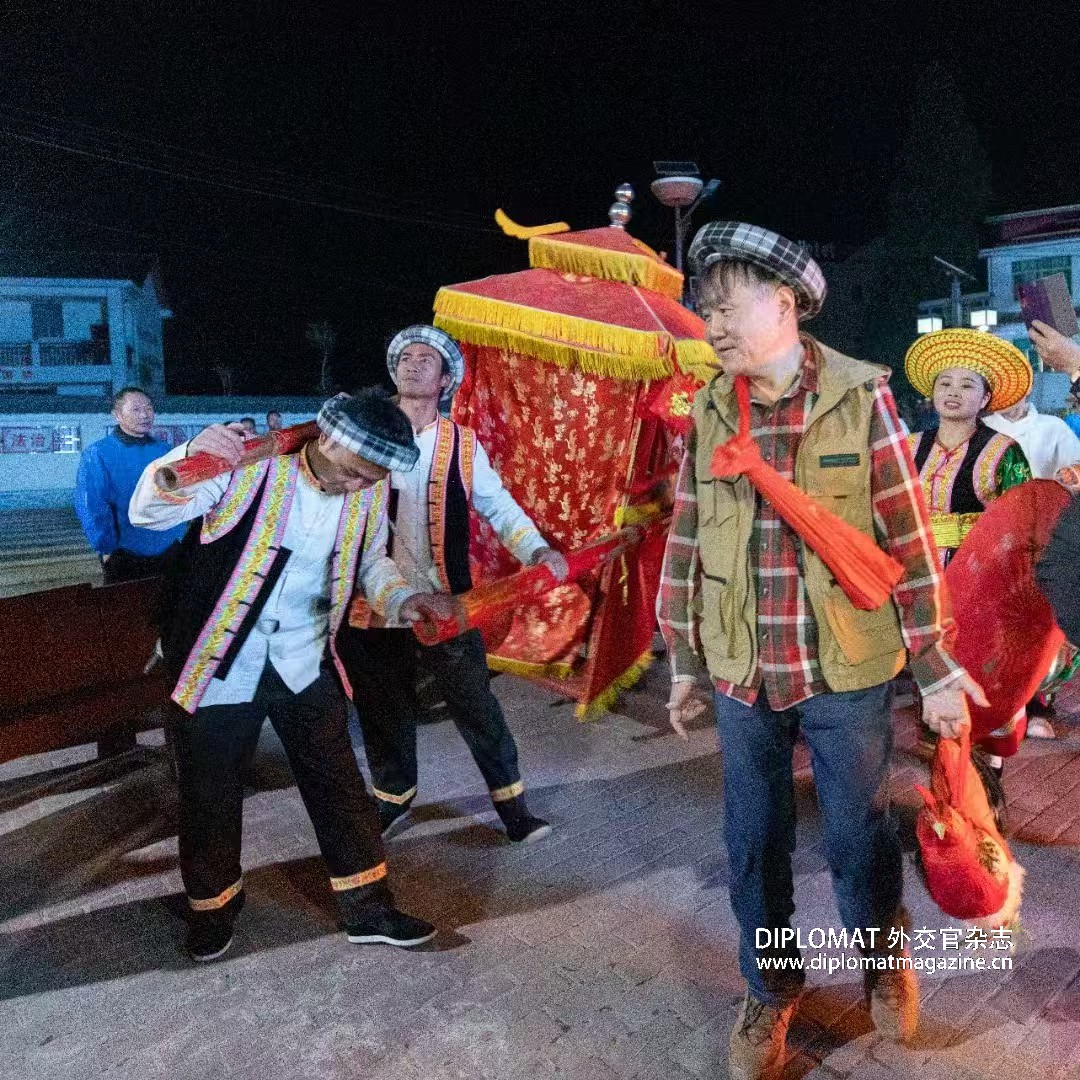
That evening, after attending a traditional long-table banquet hosted in our honor by the Huayao community, we braved the chilly early-winter wind and made our way to a village square in Huayao Township to witness their intangible cultural heritage performance—the Tiehua (Iron Flower) Dance. Though the night sky was pitch black, the village square was alive with warmth and energy, packed with several hundred villagers gathered for the event. Bright lanterns illuminated all four sides of the square, and on a large LED screen mounted on the backdrop wall, colorful promotional videos showcasing the customs and scenic charm of Huayao Township played in a continuous loop.

In the center of the crowd, a roaring bonfire blazed brightly. Two villagers swung glowing red-hot charcoal rods—striking them together as they danced. From their hands burst showers of brilliant iron sparks, soaring and swirling through the air like blossoms—truly evoking the poetic imagery from Tang Dynasty poet Cen Shen: “Suddenly, as if an overnight spring breeze had blown, thousands upon thousands of pear trees burst into bloom.”
Everyone joined hands, forming a large circle around me. Holding decorative umbrellas, we danced together while humming rhythmic work songs. The mingling sounds of chanting, laughter, crackling sparks, and joyful movement echoed throughout the mountainous Hu Xing Shan region.
Grand opera houses in big cities and fashionable street performances in urban centers certainly offer captivating cultural spectacles—but so too does this kind of joyful, self-entertaining folk tradition in remote mountain villages. Both are indispensable threads in the rich tapestry of our shared cultural landscape.
Huayao Chongmudang Ancient Village
The next morning, under the guidance of the township head of Huayao, we visited the ancient Chongmudang village of the Huayao ethnic group. We were warmly welcomed by Ms. Zheng Xiaohong, the village Party secretary. Dressed in traditional Huayao ethnic attire, Secretary Zheng carried herself with grace and competence—so much so that it was hard to imagine she was a grassroots Party cadre standing right before us.
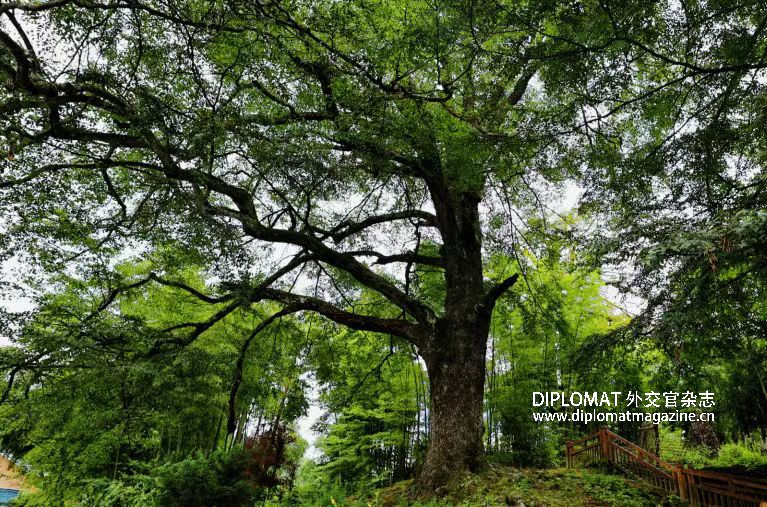
Under her leadership, we toured two representative sites in the village. The first was the Ancient Tree Park, situated high on a steep slope. At the top, the park opened into a flat area of about 500 square meters, where hundreds of ancient trees stood—mostly Greenwood tree, which more than ten were over a thousand years old. Several of these giants soared to heights of over 20 meters, with trunk diameters reaching 50–60 centimeters. Against the majestic backdrop of the Xuefeng Mountains and vast sea of forest, these towering, dense, layered ancient trees created a breathtaking scene. In the distance rose lofty mountain ridges, while below lay patchworks of golden rice fields and emerald vegetable plots—a vivid, idyllic landscape painting of an authentic Huayao ancient village.
Ms Zheng then led us through the historic lanes of the village itself, where rows upon rows of traditional dwellings cascaded down the hillside. Most houses featured wooden doors and windows, plank walls, and dark-tiled roofs. She explained that the village now offers more than 2,000 homestay beds, including her own family-run guesthouse with over 30 rooms and nearly 50 beds. In recent years, driven by China’s rural revitalization strategy, heritage tourism in this ancient village has flourished—especially during summer, when visitors from Guangdong flock to this cool mountain retreat at 1,300 meters above sea level. At peak season, accommodations are so scarce that “a bed is hard to come by.” Per capita annual income in the village now reaches approximately RMB 50,000–60,000. Looking at Ms Zheng’s proud smile, I glimpsed the genuine happiness of farmers in this remote ethnic minority village—living proof of President Xi Jinping’s vision: “China’s 56 ethnic groups must unite as tightly as pomegranate seeds; not a single one should be left behind.”

During our visit, County Magistrate Yang of Longhui shared exciting news: by June 2025, a new cable car line will open, connecting Xupu South High-Speed Railway Station directly to Huxing Mountain in Huayao Township. Spanning 7.6 kilometers, it will be China’s longest cable car system, cutting travel time between the station and the village from 1 hour 40 minutes down to just 40 minutes. As the local saying goes: “With the cable car ascending and descending, impassable gorges become thoroughfares.”
In Longhui County—a region that has successfully eradicated poverty—I witnessed the government’s efficient governance, vibrant and diverse folk customs, children receiving quality education even in remote mountains, well-preserved ecological environments, and the joyful, fulfilling lives of ethnic minority communities. If judged by global standards of national happiness indices, Longhui would undoubtedly score full marks.
I sincerely hope more international friends will visit Longhui. May Longhui step confidently onto the world stage!
By:Wu PeiQing